
【2016-2026 Ten-Year Research Brief】Metal Photographs: Conservation Science Analysis in Taiwan's Climate

Transform your precious images into gallery-grade collections that seamlessly blend into your space.
【2026 Image Preservation Science Update Statement】
We continuously track cutting-edge preservation science. Following the release of the latest literature by authoritative organizations such as the International Image Permanence Institute (IPI), we have decided to transparently share the current state of our research with you:
- Natural Aging Phenomena: No physical medium in the world is immortal. The latest research shows that the polymer coating of metal prints, when displayed for many years in Taiwan's hot and humid home environment, will still undergo extremely slow chemical aging and slight yellowing.
- Fluorescent Whitener-Free and Antioxidant Advantage: Traditional fine art inkjet papers are prone to yellowing spots due to the degradation of fluorescent whitening agents (OBA), or image fading due to the absorption of gases by microporous coatings. In contrast, metal prints are naturally OBA-free and have a sealed coating, which effectively blocks air oxidation, allowing you to display them bare with complete peace of mind, without relying on glass for protection.
Timeline of Image Preservation Science Evolution (2016-2026)
One-Minute Speed Read: Core FAQ of 10-Year Research Brief
No time for a long read? These 4 key Q&As condense 10 years of international academic preservation science for you:
Q1: How did the "65 years fade-free" measured by WIR in 2016 come about? Is it really unnecessary to add glass?
Q2: What weaknesses did international authoritative organizations (IPI, ISO) discover between 2018-2022?
Q3: Latest findings in 2025-2026: Why can't metal prints be "stored sealed in their original cardboard boxes"?
Q4: Summarizing 10 years of research, how well do metal prints hold up in a Taiwanese home environment?
Image preservation science is never an immutable dogma, but a knowledge system that gradually matures with advances in chemistry, material science, and physics. Below, we detail the evolution of understanding of the preservation limits of "dye-sublimation metal prints" within the international academic community over the past decade:
2016: WIR Lab's "65 Years Fade-Free" and "Glass-Free Bare Display" Breakthrough
Wilhelm Imaging Research (WIR), a leading US image permanence institute, published an independent accelerated aging test rating for ChromaLuxe aluminum panel metal prints, estimating their lightfast display life at 60 to 65 years. This report became a key basis for metal print manufacturers worldwide to promote "65 years fade-free" at the time.
It is highly noteworthy that WIR's 65-year rating was measured under bare display conditions, "without any protective glass or acrylic." Although the test environment was still a "controlled laboratory utopia" with a constant temperature of 25°C, constant humidity of 60% RH, and complete isolation from atmospheric ozone, the robust surface rigidity demonstrated by metal prints officially heralded the advent of the "glass-free bare display" aesthetic era.
2018: IPI Digital Print Preservation Guide Reveals "Disperse Dye" Weaknesses
The Image Permanence Institute (IPI), part of Rochester Institute of Technology (RIT), published its renowned "Guide to the Preservation of Digitally-Printed Images." This guide for the first time formally defined "dye-sublimation metal prints" as a new type of imaging material combining a polymer polyester coating with organic disperse dyes. The report explicitly stated that disperse dyes are highly sensitive to high temperatures, high humidity, and active chemical gases in the air (such as ozone). If the artwork is exposed to air filled with chemical pollutants, it will slowly erode the dye molecules, inducing photo-oxidative reactions.
2020: International Standard ISO 18936 Updated, Establishing Thermal Stability Limits
The International Organization for Standardization (ISO) updated ISO 18936, "Imaging materials — Processed colour photographs — Methods for measuring thermal stability," scientifically exploring the physical behavior of polymer polyester materials under high temperature and high humidity. The standard states that when the display or storage environment reaches its physical limits (e.g., the glass transition temperature Tg of polyester material), the pores of the polymer chains will be forcibly expanded, leading to the migration and diffusion of the sublimated dye molecules locked within. This can cause color shifts, bleeding/ferrotyping, microscopic cracks on the surface, and even delamination of the polymer layer. This international standard has erected a clear physicochemical defense line for the image preservation community.
(Learn more about physicochemical details, please refer to: "ISO 18936: Metal Print Thermal Stability and Preservation Science" White Paper)
2022: Original Manufacturer Admits "Disperse Dye" Physical Limitations at Academic Conference
At the second "Color Photography and Film Academic Symposium" held in Venice, Italy, the R&D director of Universal Woods, ChromaLuxe's parent company, in conjunction with JK Group from Italy, jointly published a paper demonstrating remarkable academic integrity.
The paper explicitly acknowledged that the disperse dyes used in dye sublimation printing are "inherently not photochemically permanent" in their molecular structure. To address this material's inherent limitation, the original manufacturer has continuously invested in research and development for ten years, developing the new Helios sublimation inks with an exquisitely optimized formula to compensate for the deficiencies of standard inks in terms of light and thermal stability. Concurrently, IPI's accelerated aging research in 2011 also indicated that under complete dark storage conditions, the dye-sublimation polymer protective layer would still undergo slow chemical degradation due to temperature and humidity, with its yellowing sensitivity being relatively high among all digital photo materials.
2025-2026: Real-World Exposure, Bidding Farewell to the Myth of Laboratory Immortality
POV, a professional art printing center in Los Angeles, USA, published a dedicated article exploring the truth about metal prints. Its conclusions completely align with the cases we have observed in practice in Taiwan: there is a huge discrepancy between laboratory "65-year utopia" data and real home environments.
In the real world, if metal prints are stored sealed in non-acid-free packaging materials (such as ordinary corrugated cardboard boxes or bubble wrap), the harmful chemical gases (offgassing) released by the packaging materials at high temperatures will be highly absorbed by the polyester layer; or in a humid environment without air conditioning, images are highly susceptible to yellowing or muddy dark details within just a few years. Weiss Imaging chooses to honestly lay these scientific truths bare, officially announcing the arrival of a scientific preservation era that "demystifies and tackles pain points" directly.
Weiss Science Class: Pigments, Dyes, and the Critical Role of Tg
1. The Analogy of Sand and Sugar Water (Pigment Ink vs. Disperse Dye)
Many creators often ask us: "What's the difference between pigments and dyes?"
- Traditional Fine Art Inkjet (Pigment): Like "sand," these are solid particles insoluble in water, adhering to the surface of the paper. Due to their large molecular structure, they are inherently highly resistant to strong light and air pollution.
- Dye Sublimation (Dye): Like "sugar water," these use organic dye molecules that are completely soluble, perfectly integrating into the coating, but are inherently more sensitive to UV light and atmospheric ozone.
2. The Fate of Organics and the Defense of Inorganics
Since organic dyes are more susceptible to light, why can ChromaLuxe aluminum panels still achieve a 65-year fade-free bare display life? This is precisely the magical physical defense of the high-temperature, high-pressure dye sublimation process: at the moment of pressing at 200°C, the dyes vaporize and are "locked deep" inside the high-hardness, completely sealed polymer polyester coating (Polyester IRL).
And its substrate is pure inorganic metal aluminum panel, which is not afraid of water and does not grow mold. In short, traditional fine art inkjet relies on the powerful "chemical stability" of the ink to resist aging; while metal prints utilize the "robust physical defense" of an inorganic metal substrate and a sealed coating, providing a protective umbrella for the vulnerable organic dyes!
3. Debunking the Fire Video Myth: How Long Until Damage Occurs After Crossing "Tg"?
Some marketing videos online use lighters to burn metal prints, claiming they are "completely resistant to high temperatures." This is actually an exaggerated visual gimmick. In rigorous materials science, what determines the fate of a polymer coating is its "Tg (Glass Transition Temperature)".
When the ambient temperature consistently reaches the Tg critical point of the polyester coating (around 50°C), the hardened coating will soften from a rigid "glassy state" to a "rubbery state," causing the locked-in dye molecules to begin migrating and diffusing.
So, once it exceeds 50°C, how long until the image degrades? 5 minutes? 5 days? Or 5 weeks?
According to a large-scale thermal stability accelerated aging study published by the Image Permanence Institute (IPI) (using the Arrhenius test method, where samples were continuously observed in high-temperature ovens at 55°C to 85°C), metal prints do not instantly melt within 5 minutes or 5 hours. Their degradation is a "slow chemical and physical process". In environments exceeding 50°C, it typically takes several weeks to several months (e.g., tens of weeks in the experiments) of continuous "baking" to produce severe color shifts and yellowing visible to the naked eye.
Although it has extremely strong resistance to transient high temperatures (such as hot water spills or brief exposure to direct afternoon sun), we still strongly urge: never leave metal prints sealed for extended periods (several weeks or more) in a hot car trunk in summer, or in an unventilated tin-roofed warehouse on the top floor!
Weiss Sister's Honest Declaration: Why is this scientific report only now appearing?
Perhaps you're wondering, since relevant literature has been available internationally since 2022, why is Weiss Imaging only publishing this report in 2026? This is not intentional concealment on our part, but an unexpected and profoundly real education.
We have always closely followed the official information from ChromaLuxe's US headquarters. In April of this year (2026), we noticed that the original manufacturer's website had not been updated with research data for a long time, and we even proactively contacted our familiar official representative to request the latest safety and outdoor weather resistance reports for aluminum panels. At the time, we received a very polite reply stating that their team would assist, but then it went silent. We initially thought it was just a delay in the manufacturer's administrative process and set it aside for the time being.
Until June of this year, a former buyer contacted us. He mentioned a piece from a past exhibition that was packed in its original packaging, shipped back, and stored in a warehouse. Three years later, when he opened it, he found that the entire color had shifted.
This real-world case completely woke us up! We immediately launched an independent research team, bypassing the manufacturer's marketing claims, and delved directly into international academic journals and preservation science literature. It was then that we realized that as early as a 2022 academic symposium paper in Italy, and a 2025 practical article by our US counterpart (POV printing center) in Los Angeles, the thermal degradation phenomenon of metal prints' "intolerance to sealed dark storage" had already been revealed.
This is why this technical report, devoid of marketing and 100% candid, is being released at this time. We believe that honestly laying these scientific truths bare is the most responsible attitude towards every creator and collector.
Laboratory Ideal Environment vs. The Harsh Reality of Taiwan's Climate
Why do we constantly emphasize the huge discrepancy between "laboratory data" and "real-world display"?
1. The Overlooked Reality of High Humidity in Taiwan
When WIR conducted accelerated aging tests, the reference relative humidity was set at a constant 60% RH. However, according to official climate data from the Central Weather Administration, the annual average relative humidity in major Taiwanese cities generally exceeds 74%.
In such a high-humidity island climate, if the display space does not have 24/7 air conditioning or dehumidification, traditional fine art inkjet papers will absorb moisture from the air like sponges. This not only triggers the germination of mold and fungal spores but also promotes the oxidation of trace metals within the paper, ultimately inducing irreversible "foxing" in the bright areas of the artwork.

▲ Microscopic detail: Miniature condensation caused by temperature differences is quietly softening the microporous coating on the photo paper surface.

▲ Current state of inkjet prints: Traditional paper is highly susceptible to irreversible wavy deformation and degradation due to environmental humidity.
2. Autocatalytic Degradation of Fluorescent Whitening Agents (OBA)
Traditional fine art inkjet papers often heavily incorporate fluorescent whitening agents (OBA) during manufacturing to achieve a dazzling "cool white tone." However, OBA is inherently extremely unstable and undergoes rapid, irreversible chemical degradation when catalyzed by air, high temperature, high humidity, and UV light. This causes large areas of the artwork's originally pure white regions to fade and develop persistent "yellowing stains." This is particularly common on traditional RC coated photo papers and represents a major chemical hazard in the preservation of inkjet prints.
3. Microporous Coated Paper and Gas Fading
Most fine art inkjet papers have a "microporous coating" on their surface designed to absorb ink. The physical structure of this coating is like a sponge; while it allows ink to dry quickly, it also actively and continuously absorbs atmospheric pollutants (such as kitchen fumes, ozone produced by laser printers and air purifiers, and acidic nitrogen dioxide). These pollutants combine with the ink pigments and undergo photo-oxidation reactions, leading to large-scale color shifts and distortion in the image, academically known as "gas fading."
The Hidden Traps of Traditional Framing: Microclimate Condensation and Sticking Crisis
Many photographers and collectors, to protect their paper-based works, invest heavily in traditional framing shops to add glass or acrylic protective layers. However, this seemingly protective action, if improperly handled in a temperature-fluctuating island environment, can ironically trigger the physical tragedy of "microclimate condensation."
According to research by international preservation physicists, sealing highly hygroscopic photo paper between glass and backing board creates a relatively enclosed "microclimate greenhouse." When indoor temperatures fluctuate drastically (e.g., frequent turning on and off of air conditioning), a thermal gradient is generated within the frame. Water vapor will reach its dew point and condense into miniature droplets on the coldest surface inside the frame (such as the cold inner side of the glass), quietly soaking and softening the photo paper.
If the photo paper is not adequately spaced with a mat board during framing, the water-absorbed and softened image layer will adhere tightly to the glass like glue, leading to irreversible "blocking & ferrotyping." If an attempt is made to forcibly separate them in the future, the valuable image will be completely torn apart. (For a deeper discussion on photo safety, acid-free materials, and framing specifications, please refer to: "ISO 18902: Framing, Display, and Materials Safety Science" White Paper)

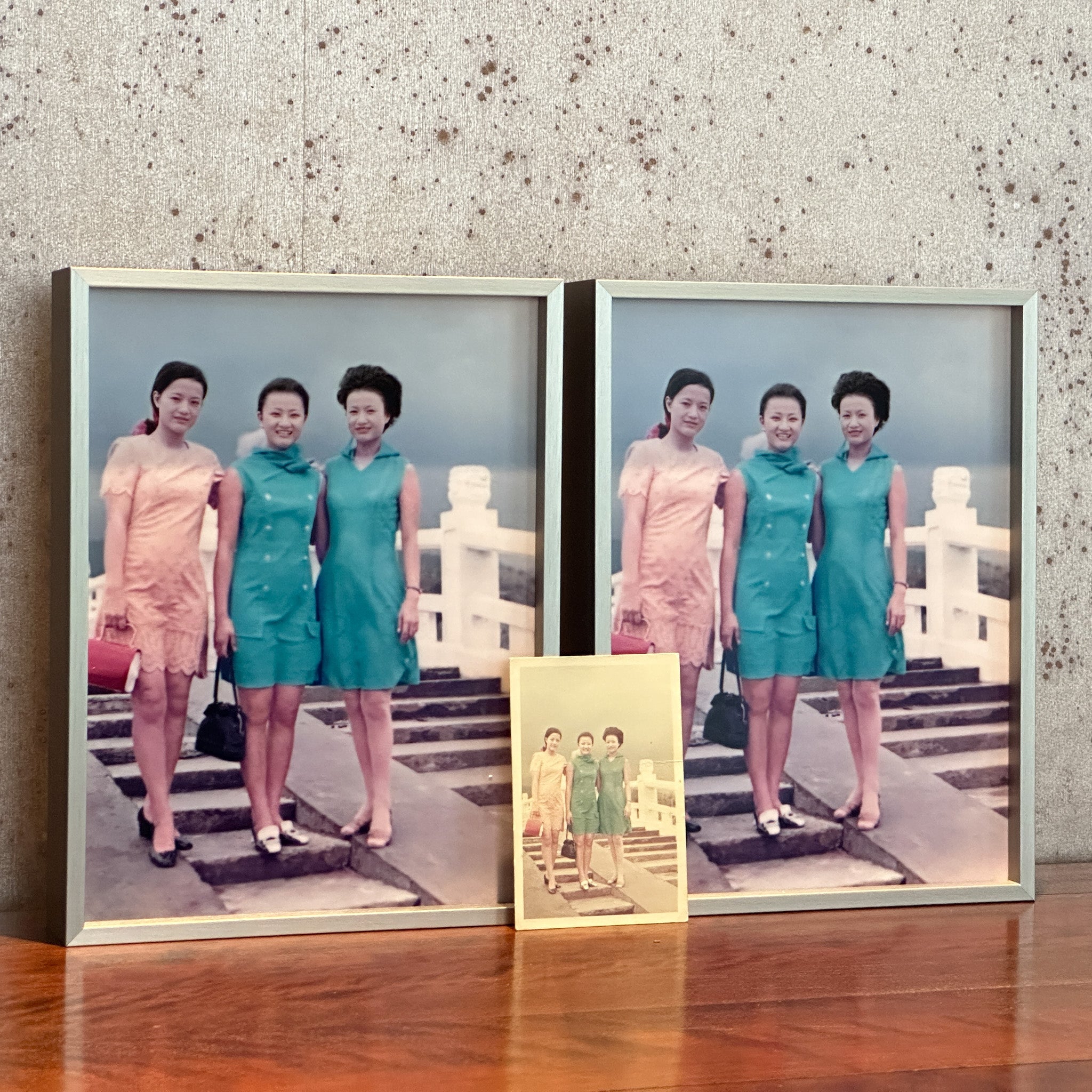
▲ Current Status in June 2026: (Left) 2018 Metal Print, (Middle) 2019 Frameless Metal Print, (Right) 2018 Traditional Paper Framing.
Media Selection Guide: Which One Should You Choose for Your Environment?
After reviewing the arduous scientific evidence above, let's return to the most practical question: "So, which type of artwork should I choose, and how should I care for it once I bring it home?"
We have compiled this comparison table for you. Please make your final decision based on your "actual display environment":
| Key Environmental Factor | Traditional Fine Art Inkjet Paper (Giclée Print) | ChromaLuxe Metal Print | Honest Scientific Conclusion: Which is more vulnerable? |
|---|---|---|---|
|
Humidity (Taiwan average humidity > 74%) |
【Extremely Fatal】 Paper fibers absorb moisture like a sponge, leading to wavy cockling and are highly susceptible to inducing irreversible "foxing." |
【Can be Immune】 Pure inorganic aluminum panel and polymer coating inherently have no pores, providing excellent everyday water resistance and moisture resistance. |
Paper is extremely sensitive to humidity. In a Taiwanese home environment without moisture control, metal prints offer superior defense. |
|
Temperature and Temperature Fluctuations (Air-conditioned room or hot and stuffy) |
【Temperature Fluctuation Fatal: Condensation Sticking】 Frequent turning on and off of air conditioning creates "thermal gradients" within the frame, causing condensation on the inside of the glass, which softens the microporous coating of the photo paper and leads to it "blocking" onto the glass. |
【High Temperature Fatal: Exceeding Tg Limit】 If left sealed for extended periods in high-temperature environments exceeding approximately 50°C, the polymer coating will soften, causing dye migration, bleeding, and delamination. |
Both are vulnerable, but through different mechanisms. Paper is susceptible to glass condensation caused by "temperature fluctuations"; metal prints are susceptible to chronic "baking" in "extreme high temperatures." |
|
Storage Without Opening (Sealed in original box / Dark space) |
【Relatively Safe】 Provided that "OBA-free" and acid-free photo paper and packaging materials are used, the pigments and paper can maintain stable chemical properties in the dark. |
【Extremely Fatal: Thermal Degradation and Chemical Yellowing】 Dye-sublimation materials have extremely high yellowing sensitivity when stored in the dark without light, affected by temperature and humidity. If also sealed in ordinary corrugated cardboard boxes, offgassing from packaging materials will be absorbed by the coating, rapidly accelerating severe yellowing within just a few years. |
Metal prints are extremely sensitive to sealed boxes. Metal prints should absolutely not be stored in boxes in a storage room for long periods; they must be unpacked and ventilated. |
|
Light and Air (UV, Ozone Pollution) |
【Yellowing and Gas Fading】 If containing fluorescent whitening agents (OBA), they will degrade and yellow when exposed to light; and the microporous coating will absorb ozone, leading to "gas fading" of the pigments. |
【Photo-oxidative Fading】 Organic dyes themselves are extremely sensitive to strong light and ozone. However, the dyes are deeply locked within the coating, forming a strong "air-tight physical barrier." As long as the coating is not damaged by high temperatures or scratches, it can largely block ozone erosion. |
Paper is susceptible to air, dyes are susceptible to strong light. Both should avoid strong direct light. Metal prints are not inherently immune, but rely on "non-porous physical obstruction" to block ozone on the exterior, minimizing the risk of gas fading. |
Summary: Which material should you choose for printing?
Option A: If you choose "Fine Art Inkjet Paper"
- Suitable environment: Professional galleries, archives, or indoor spaces with extremely stable temperature and humidity, equipped with 24-hour constant temperature and humidity control (relative humidity maintained around 50%).
- Required framing method (heavy-duty defense): Fine art inkjet prints absolutely cannot be "hung bare." You must invest in high-standard museum-grade frames: the front must be equipped with "UV-blocking acrylic" to block UV rays and pollutant gases; a "pure cotton acid-free mat board" must be used in the middle to separate the artwork from the acrylic, strictly preventing condensation and sticking; the back must use "acid-free corrugated board" to block moisture from the wall.
Option B: If you choose "Metal Print"
- Suitable environment: 99% of real home environments in Taiwan! Including living rooms, dining rooms, hallways, and even bathroom exterior walls where moisture can be present.
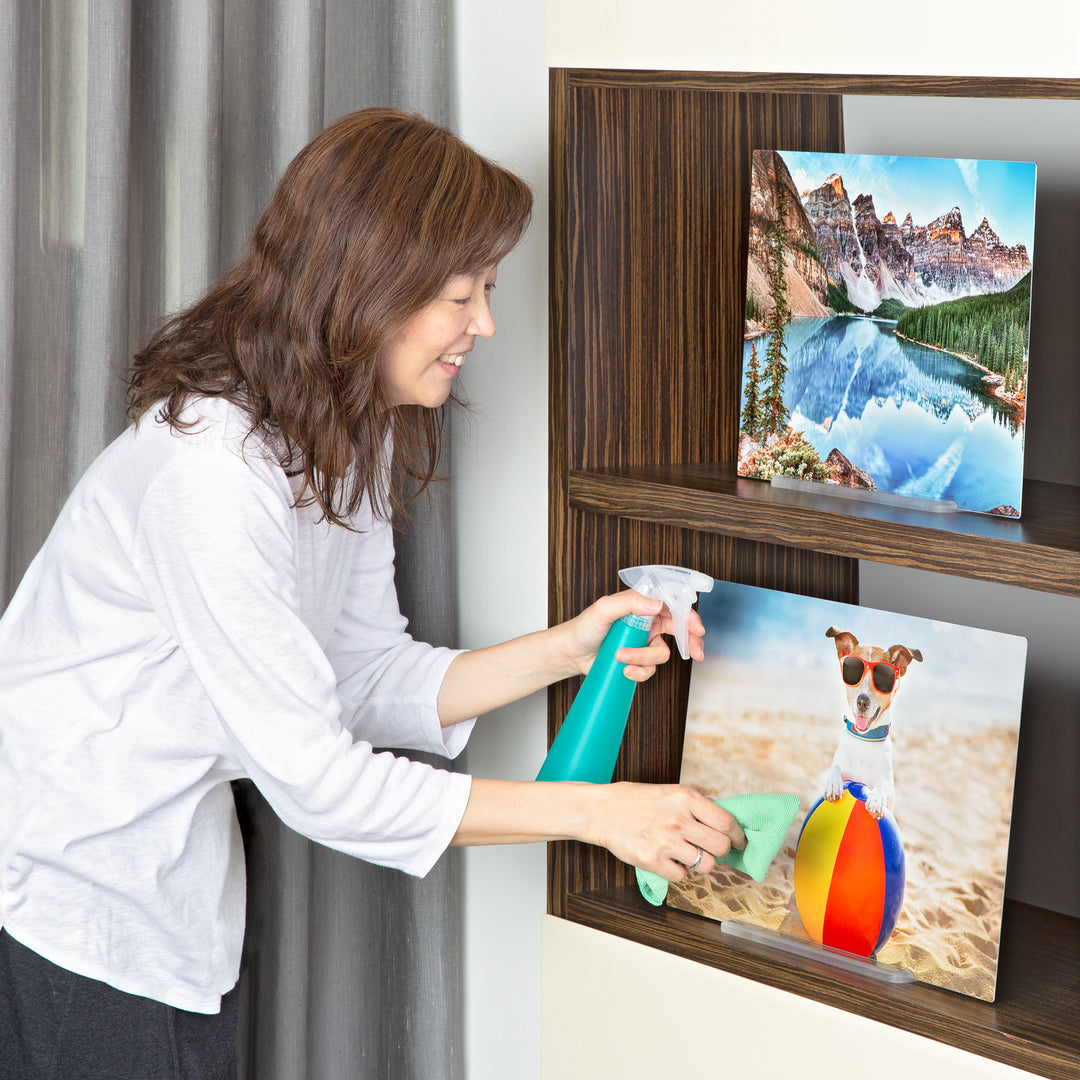
- Required framing method (light and airy, let it breathe): Metal prints come with built-in protective armor and absolutely do not require additional glass protection. It is strongly recommended to avoid enclosed framing. Their most perfect state is paired with a dedicated "floating back frame" or "double-layer aluminum frame," allowing them to be hung directly on the wall with air circulation. This not only eliminates the visual interference of an extra layer of glass, allowing you to directly appreciate the transparent, three-dimensional luster of the image on the metal surface, but also avoids the chemical risks of thermal gradients and gas absorption. For daily cleaning, simply use a slightly damp soft cloth to dust it off.
Weiss Sister's Honest Declaration
Honestly, in Taiwan's climate with an average humidity exceeding 74%: If you seek the ultimate warmth and texture of classical paper, you must be prepared with "heavy-duty equipment and budget" to combat humidity; if you wish for your artwork to seamlessly and effortlessly integrate into your home life, free from worries about mold, dehumidification, and additional framing, then a metal print, with its inherent physical protective armor and suitability for bare display, is absolutely your most reassuring choice.
No physical medium in the world is immortal. The reason we insist on moving forward with the latest international museum preservation science, and candidly revealing all limitations of degradation to you, is because we deeply believe that only by continuously updating our understanding of materials with the latest data can we calmly face the test of time; allowing these handcrafted images, printed for you, to become your most worry-free and authentic companions in your daily life for years to come.
【References and Academic Sources】
To ensure the scientific integrity and academic traceability of this report, the international academic journals, standards, and industry literature cited herein are detailed below:
1. International Standards and Authoritative Preservation Institute Guidelines
INTERNATIONAL STANDARD ISO 18936:2020(E)
Document Title: Imaging materials — Processed colour photographs — Methods for measuring thermal stability
Key Focuses:
• (Scope): Specifies that this standard applies to processed photographic prints, including traditional silver-halide, thermal transfer, dye sublimation, and inkjet prints, for dark storage thermal stability testing.
• (Section 6): Clearly stipulates controlled physical environment of constant temperature 23°C ± 2°C, relative humidity 50% ± 10%, and that ozone-sensitive samples must be stored in an ozone-free environment (<2 nl/l).
• (Section 7): Distinguishes in detail between the "sealed bag method" for simulating sealed box storage where gases cannot escape, and the "free hanging method" for simulating bare display in the air.
INTERNATIONAL STANDARD ISO 18902:2013(E)
Document Title: Imaging materials — Processed imaging materials — Albums, framing and storage materials
Key Focuses:
• (Section 3.6): Strictly defines multiple comprehensive physical and chemical indicators for "photo-safe" materials, establishing that simply meeting acid-free (pH) criteria or a single PAT test is insufficient to claim photo-safety.
• (Section 4.2): Explicitly prohibits the use of PVC (polyvinyl chloride) storage sleeves containing chemical plasticizers to prevent softening, dissolving image coatings, and causing severe sticking.
• (Section 4.3): Specifies that metals used for framing and support structures must be non-corrosive and chemically inactive, such as anodized aluminum.
• (Section 4.6): Stipulates UV blocking rates for display frames, and explicitly mandates that artworks and protective glass must never directly touch, to prevent condensation due to temperature differences leading to adhesion problems.
Image Permanence Institute (IPI) Guide (2018)
Document Title: IPI’s Guide to: Preservation of Digitally-Printed Images, Rochester Institute of Technology (RIT).
Key Focuses:
• (Section 6): Documents the history of the dye sublimation phenomenon and identifies physical structures (disperse dyes, polymer polyester coatings, substrate material).
• (Air Pollution & Enclosures): Points out the destructive mechanisms of active atmospheric pollutants on printed materials, warning that offgassing from sealed packaging materials can cause accelerated yellowing.
• (Handling): Strongly recommends wearing lint-free nitrile gloves when handling unframed artwork to prevent fingerprint residues from causing chemical reactions.
2. Laboratory Test Reports and Academic Papers
Gruppo del Colore Academic Symposium Paper (2022)
Document Title: ChromaLuxe and New Generation Helios Sublimation Inks (presented at the Second "Color Photography and Film Academic Symposium" in Milan, Italy).
Key Focuses: Co-published by the R&D director of ChromaLuxe's parent company, acknowledging that disperse dyes are inherently not photochemically permanent in their molecular structure, and publicly revealing the scientific process of the original manufacturer's investment in developing the new generation "Helios" inks to overcome these defects.
Wilhelm Imaging Research (WIR) Test Announcement (2016)
Document Title: ChromaLuxe Achieves Three Times the Print Display Permanence Rating Compared to Silver-Halide Color Papers.
Key Focuses: WIR announced that the 60-65 year lightfast display life rating for metal prints was measured under bare display conditions, "without any glass or acrylic protection."
Journal of the American Institute for Conservation (AIC) Paper (2011)
Document Title: Yellowing of Digitally Printed Materials in Cultural Heritage Collections.
Key Findings: IPI scientists, through accelerated aging tests, confirmed that dye-sublimation prints exhibit the highest sensitivity to chemical yellowing caused by temperature and humidity in completely dark storage environments, revealing a physical limitation where chemical degradation slowly occurs.
3. Practical Tests and Real-World Environment Documents
POVevolving Studio Blog (2025)
Document Title: The Truth About “Metal Prints” aka Dye Sublimation, POV Professional Art Output Center, Los Angeles.
Key Findings: Practical tests by a professional output center in Los Angeles confirmed that if metal prints are sealed and stored in a completely dark filing cabinet, they are highly prone to color shifts, muddy dark details, and a yellow cast in the substrate within a few years. This demonstrates the chemical damage caused to polymer coatings by "improper sealed storage."