
Acrylic Prints vs. Metal Prints: A Guide to High-Quality Frameless Art Prints and Their Preservation

The pursuit of ultimate gloss often comes with a rigorous test of material stability.
If you're interested in learning more about "acrylic face mounting," you likely want your work to exhibit that crystal-clear, museum-quality three-dimensionality and the frameless visual tension characteristic of contemporary art.
Many friends who see ChromaLuxe metal prints for the first time exclaim, "This looks just like a super lightweight version of acrylic face mounting!" However, we must caution you right from the start: Weiss Image does "not" offer acrylic face mounting services, and currently, no manufacturer in Taiwan possesses genuine Diasec® original patent certification.
This article is a sharing of real experiences, born from our respect for photographic craftsmanship, and based on lessons learned in 2018 and research into international specialized articles, written for creators.
If you're seeking the highest-quality frameless glossy finish for your exhibition, you have two options in Taiwan: one is to find a local "acrylic lamination company" with excellent technique but still requiring long-term validation; the other is to choose a new, integrated contemporary medium—ChromaLuxe metal prints. We hope this objective research guide helps your hard work find its perfect home.
The Authentic Acrylic Face Mount Praised by International Masters: Diasec®
Internationally, the authentic acrylic face mount is known as Diasec®, a patented mounting technique with extremely high barriers to entry. It uses an exclusive liquid gel with UV-resistant properties to directly bond highly transparent acrylic (PMMA) to the front of a fine art inkjet print, with an aluminum composite panel reinforcing the structure on the back.
Due to the refractive properties of acrylic, the colors of the artwork become exceptionally vibrant, and the dark areas appear deeper. This technique is most celebrated in the international contemporary art scene by German photography giant Andreas Gursky. His monumental masterpiece from 2001, "99 Cent II Diptychon," utilized the Diasec® process to seamlessly encapsulate an image reaching 3 meters in height beneath acrylic. This work fetched over US$3.34 million at an auction in 2007, shocking the global art world. Gursky's preference for this technique stems from its ability to imbue images with a crystal-clear, profound three-dimensionality that seems to draw viewers directly into the frame.
Photography Craft Bonus: If you wish to witness Gursky's globally stunning colossal masterpiece, please play the explanatory video below and skip to 2:00 for precious video footage!
Sister Weiss Explains: An Introduction to Diasec Acrylic Face Mounting
If you want a quick overview of the history and features of acrylic face mounting, please watch this short explanatory video we recorded for creators:
The Rise of New Techniques and the Test of Time
The genuine Diasec® technique has extremely high barriers to entry; core materials are supplied exclusively by the original Swiss manufacturer, and licensed workshops must undergo strict certification and training. Consequently, both domestic and international markets have developed their own "non-patented acrylic lamination technologies" (often referred to as Photo Print Under Acrylic Glass or Acrylic Face Mounting).
We fully believe in the breakthroughs and efforts of dedicated businesses in technical development. However, as guardians of imagery, we also want to voice our concern: the biggest challenge for these non-patented new methods is the lack of "more than one or two decades of time validation."
Sister Weiss's Experience: Our Insights and Reflections from 2018
We firmly believe that practice yields true knowledge. In 2018, we personally ordered "acrylic face mounted" works using non-patented technology from a domestic manufacturer for testing. However, after just a few years, we observed that the deterioration of the works was faster than expected: the image layer gradually degraded, and even "bubbles" and delamination began to appear irreversibly between the acrylic and the photographic paper.

This made us realize the profound complexities involved. If recycled acrylic (which yellows easily) or adhesives with poor airtightness are used, it poses a potential crisis for the creator's hard work. After this experience, we deeply feel that materials and mounting techniques that can withstand the test of time are crucial considerations for archiving image creations.
👉 This is why we ultimately chose to focus on metal prints backed by international authority:
【Authoritative Test】How long do metal prints last? Analyzing the WIR Durability Report
Two Major Overlooked "Hidden Pain Points" of Acrylic Face Mounting
Besides the risk of delamination and bubbling, acrylic face mounting techniques also present two significant limitations that trouble many creators and collectors regarding physical display and daily maintenance:
1. Fragile Surface Protection – A Cleaning Challenge Even for Museum Conservators
Acrylic (PMMA) naturally generates static electricity, attracting dust. However, its most critical weakness in maintenance lies in its "very low surface hardness" and "extreme sensitivity to chemical solvents." Long-term experiments by photo conservators at the Museum of Modern Art (MoMA) and The Metropolitan Museum of Art (The Met) have demonstrated that the daily maintenance of acrylic faces these uncompromising challenges:
- Unavoidable Micro-scratches: Laboratory data shows that even with the highest-grade microfiber cloths or wool dusters, any "contact-based" cleaning will leave microscopic scratches on the acrylic surface. As the frequency of daily dusting increases, these "sunray" scratches will make the originally crystal-clear work appear hazy and lose its luster.
- Crazing Caused by Solvents: Acrylic has insufficient resistance to chemical solvents. Misusing alcohol, glass cleaner, or any solvent-containing cleaning fluid will not only leave residues but also, over time, destroy the chemical bonds of the acrylic, leading to internal crazing and subsequent image blurring.
- Physical Deformation (Warping) Induced by Humidity: In Taiwan's typical high-humidity environment, due to the differing expansion rates of the acrylic panel on the front and the photographic paper and backing board on the back when absorbing moisture, stress tension can easily occur. This is often the reason why many large-sized acrylic-mounted works are prone to warping and deformation over time.
For these reasons, international museum maintenance guidelines usually strongly recommend "avoiding physical contact with the acrylic surface as much as possible" (e.g., using only air blowers for dusting). This extremely fragile physical property undoubtedly significantly increases the psychological burden for exhibition setup and collectors' daily maintenance.
2. Extremely Heavy Weight Burden
Acrylic face mounting involves a solid three-layer structure of "thick acrylic + fine art inkjet print + aluminum composite backing." Furthermore, to counteract the deformation stress mentioned above, it often requires a sturdier aluminum frame for support, making the overall weight astonishingly heavy. This not only significantly increases air freight or courier logistics costs but also places immense demands on the gallery's wall bearing capacity and hanging hardware, severely limiting flexibility and safety during exhibition setup.
Physical Extremes Showdown: Acrylic Face Mounting vs. Metal Dye Sublimation
If you're looking for a frameless, contemporary home for your photographic artwork, here's an objective analysis of these two techniques:
| Evaluation Metric | Non-Patented Acrylic Face Mounting | ChromaLuxe Metal Prints |
|---|---|---|
| Detail & Sharpness |
Extremely fine. As the base material is fine art inkjet paper, it can present the most perfect minuscule details and pure black-and-white grayscale. |
Deep & dimensional. High-temperature heat pressing infuses dyes into the coating. While not achieving the ultimate micron-level detail of photo paper, it possesses strong 3D visual tension. |
| Scratch Resistance & Cleaning Maintenance |
Extremely prone to scratches. Any contact-based wiping will leave micro-scratches. Solvents are strictly forbidden for cleaning. |
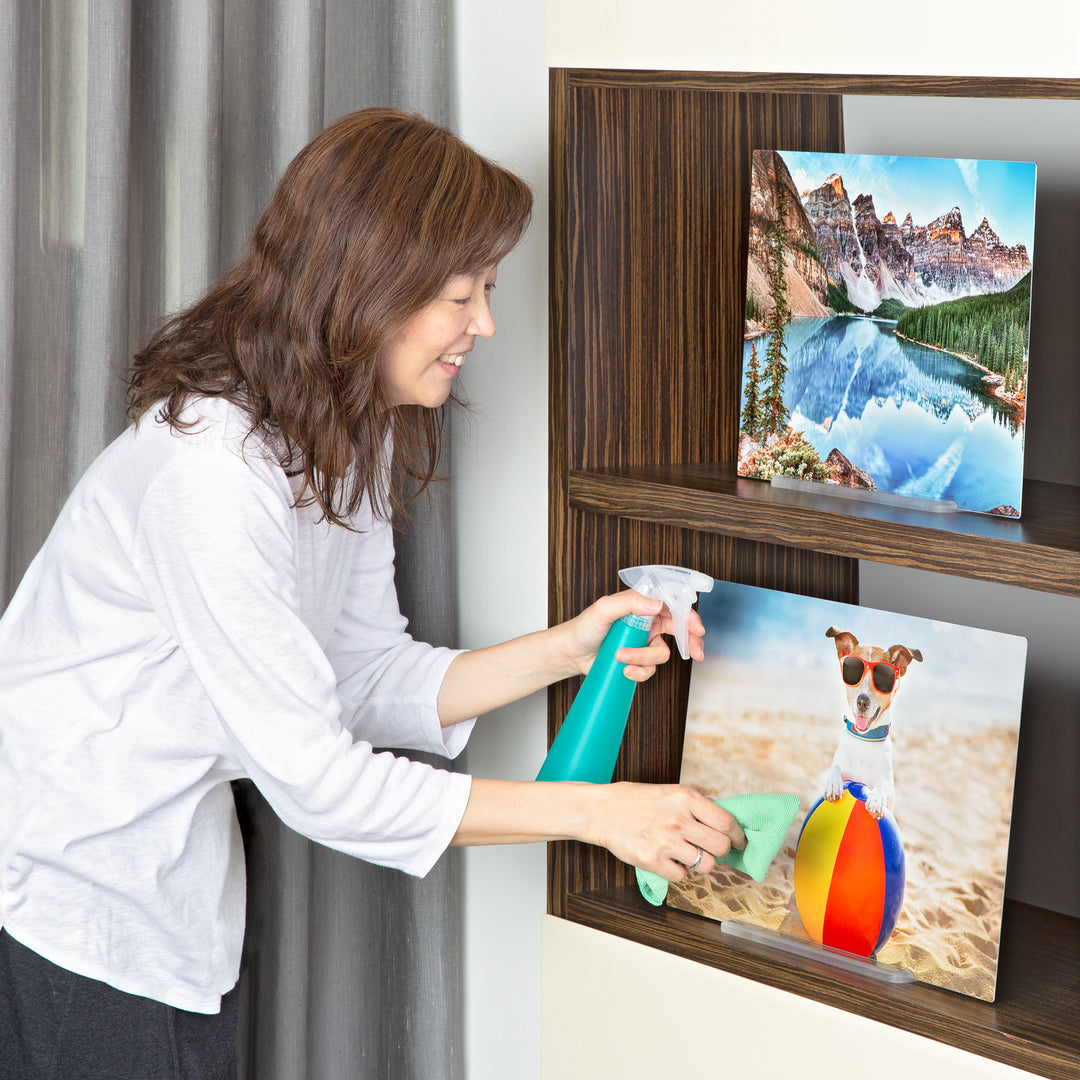
Extremely scratch-resistant. The surface is hardened and can be easily cleaned with water or diluted alcohol. |
| Structural Stability & Moisture Resistance |
Three-layer lamination, risk of delamination and deformation. Tests adhesive quality and time. Changes in environmental temperature and humidity can cause warping. |
Integrated, 100% waterproof and moisture-proof. Non-porous aluminum metal panel, impervious to Taiwan's high temperatures and humidity, no concerns about delamination. |
| Weight & Display |
Extremely heavy. Large-sized works are a severe test for walls and hanging systems, with high shipping costs. |
Relatively lightweight. Only 1.14mm thick metal panel with a hidden sub-frame, can be easily hung with one hand. |
The core image of an acrylic face mount is essentially a fine art inkjet print. If you are deliberating between the two, we strongly recommend reading our other in-depth review: Fine Art Inkjet Print or Metal Print? A Guide to Top-Tier Printing Options
Helpful Tips and FAQs for Ordering Acrylic Face Mounts
If you have an absolute insistence on the fineness of fine art inkjet paper, and are willing to accept the risks of delamination and cleaning by opting for commercial acrylic face mounting, to protect your hard work and rights, we recommend confirming the following three points with the vendor before ordering:
1. Do you use "new" or "recycled" acrylic panels?
High-quality acrylic face mounts must be made from virgin PMMA. If the vendor uses recycled acrylic to cut costs, the material will not only have more impurities affecting transparency, but it will also be very prone to severe yellowing after a few years.
2. What kind of adhesive do you use? Does it have UV protection?
This is the most crucial aspect of acrylic face mounting. Adhesives with poor airtightness will lose elasticity over time, leading to network-like cracking, and quickly delaminate and bubble in Taiwan's humid climate. Be sure to confirm with the vendor the chemical stability of their adhesive and whether it has UV protection data.
3. Can you provide examples of acrylic face mounts you made more than 5 years ago for me to assess their current condition?
The stability of a technique must ultimately be verified by time. Don't just look at freshly made beautiful finished products. Requesting to see the current condition of works produced by the vendor 5 years ago is the most authentic litmus test for their acrylic lamination method and moisture resistance.
Conclusion: We Choose Stability and Lightness
We deeply respect the artistic status of genuine Diasec®, and we wrote this article with a passion for researching professional media. We do not sell acrylic face mounts because, as supporters of creators, we have chosen a path that is more friendly to Taiwan's climate and more time-tested.
If you don't want to gamble with the risk of delamination and bubbling, nor face the heavy weight during exhibition setup and the cleaning challenge of scratching with every wipe—we invite you to experience the sturdy, lightweight, purely frameless ChromaLuxe metal prints that can provide you with long-lasting, stable companionship.
Regarding the physical properties, maintenance research, and market data of face-mounting, reference sources include:
-
Basic Care of Face-Mounted Photographs at The Museum of Modern Art, by Erin Murphy, The Museum of Modern Art (MoMA) / Topics in Photographic Preservation, Volume 12 (2007).
(Corresponds to: Scientific testing showing micro-scratches on acrylic face mounts/acrylic surfaces even with contact-based cleaning, potential risks of chemical solvents on acrylic, and museum recommendations for daily dusting and packaging guidelines) -
Research on Methods for Cleaning Face-Mounted Photographs, by Luisa Casella and Camille Moore, The Metropolitan Museum of Art (The Met) / Topics in Photographic Preservation, Volume 13 (2009).
(Corresponds to: Further confirmation through microscopy and practical testing that any contact-based cleaning causes varying degrees of micro-abrasions and scratches on acrylic surfaces, and the limited effectiveness of anti-static equipment for dust removal) -
Acrylic Face Mounting: How to make a print really stand out, by Steve Yarbrough, Sign Media Canada (2019).
(Corresponds to: The characteristic of acrylic material being highly susceptible to humidity and temperature, and the physical mechanism by which stress can occur and lead to warping when the front and back of the artwork absorb moisture or expand/contract at different rates) -
Mastering Mounting: Facemount Pros & Cons, by Chris A. Paschke, Picture Framing Magazine (2017).
(Corresponds to: The pain points of deterioration, such as spiderweb-like wrinkling on the image surface or localized delamination and bubbling at the edges, when the adhesive loses elasticity as acrylic expands and contracts due to changes in environmental temperature and humidity) -
99 Cent II Diptychon, Wikipedia.
(Corresponds to: The historical art market data of German contemporary photography giant Andreas Gursky's monumental diptych, created using genuine Diasec® acrylic face mounting technique, achieving a record-breaking auction price) -
WIR ChromaLuxe: Understanding Wilhelm Test Report for ChromaLuxe, Metal Print Studio.
(Corresponds to: The authoritative WIR test report providing physical evidence of ChromaLuxe metal prints being 100% waterproof and moisture-proof, extremely scratch-resistant, and highly durable even in harsh environments)